The problem
Where overseas hardware projects usually go wrong
Buying IoT or electronic hardware from China gets difficult when the supplier's claims, the SDK, the documentation and the real device don't match. From Europe, Australia or the US, it's hard to tell which one is at fault.
The device doesn't match the datasheet
A feature works on the supplier's demo, then behaves differently on your phones, your network, or the next production batch.
"Battery level: 1% resolution" turns out to be 10% steps.
The English docs lag the real SDK
The Chinese documentation is current. The English version is a release behind, and the method your team is calling no longer exists.
Your engineers spend a week on a problem a Chinese app note already explains.
Every question costs a week
Time zones, translation and international shipping turn each round of "please fix and resend a sample" into weeks, not days.
Samples cross a border twice before anyone knows whether the fix worked.
What I do
Engineering validation, done in China, for the buyer
You get someone on the ground who can read the Chinese docs, run the device on a real bench, and push the supplier for answers, before you commit more engineering time or ship hardware overseas.
Validate the real device
Check the physical sample against the supplier's datasheet and the claims they made to you.
Test the SDK and API
Run the supplier's SDK and demo app, integrate it into a minimal Android or Flutter app, and see what actually happens.
Check BLE and Wi-Fi behaviour
Pairing, reconnect, provisioning, OTA, gateway and cloud behaviour, logged with nRF Connect, logcat and HCI snoop.
Reproduce your issues
Recreate the bugs your team or customers reported, on the same hardware, with step-by-step reproduction and recordings.
Talk to the supplier's engineers
Raise findings with their engineering team in Chinese, verify their explanations and fixes, and summarise every exchange for you in English.
Deliver an English assessment
A structured report with findings, evidence, integration risks and a clear recommendation you can take to your team.
This is a technical assessment service, not sourcing. I take no commission from suppliers.
Why do it in China
The sample never has to leave the country to be tested
The advantage isn't shipping cost. It's how many test rounds you can fit into a week, and the fact that a bad unit is caught before it crosses a border.
| Testing it yourself overseas | With me in Qingdao | |
|---|---|---|
| Sample reaches the tester | 7–15 days international courier, plus customs | 1–2 days domestic courier |
| Supplier ships a fixed unit | Another international round trip | Here in two days |
| Test rounds per evaluation | Usually one, sometimes two | Three or four |
| Questions to the supplier | In English, across the time zone | In Chinese, same working day |
| A unit fails the test | It has already been exported and imported | It never leaves China |
How it works
Four steps, one agreed scope
Every engagement starts by agreeing exactly what will be tested. Only those functions are in scope, so you know what you're paying for and what the report will cover.
Scope review
I review your requirements, the supplier documentation and the functions you list, then confirm the test scope with you before any testing starts.
All packagesTechnical evaluation
I test the agreed device, SDK and API behaviours. With a physical sample, this starts when it arrives and includes issue reproduction on real hardware.
Hands-on from StandardSupplier clarification
I raise findings directly with the supplier's engineers in Chinese, verify their explanations or fixes, and summarise each exchange for you.
AdvancedFinal report
You receive a structured English report with findings, photos, recordings, logs, integration risks and a recommendation.
All packagesWhat gets tested
Mobile, IoT and physical hardware in one place
Most problems sit at the boundary between the device, the SDK and the app. That boundary is where I work.
Mobile
- Android and Flutter app integration
- Native SDK behaviour and callbacks
- Device-state synchronisation
- Behaviour across phone brands
- iOS by prior agreement
IoT
- BLE pairing, GATT and reconnect
- Wi-Fi provisioning
- Gateway, cloud and API behaviour
- Firmware and OTA updates
- Platforms such as TTLock and Tuya
Hardware
- Real sample on the bench
- Issue reproduction
- Photos and screen recordings
- Before / after comparison of fixes
- 3D-printed test fixtures
Packages
Fixed price, fixed scope
Each order covers one supplier, one product and one agreed list of functions. Larger or multi-product projects get a custom quote.
Remote Technical Review
Before you buy samples: is there an obvious technical risk?
- Review of supplier technical claims
- SDK, API and documentation quality, including Chinese docs
- Integration risk review
- Questions to put to the supplier
- Concise English assessment
Sample Technical Validation
You have a sample and need to know how it really behaves.
- Set up and test one physical sample
- Run the supplier SDK and demo app
- BLE, Wi-Fi and API checks where applicable
- Basic Android integration and issue reproduction
- Photos, recordings and English report
Supplier Engineering Check
You need the supplier's engineers to answer, fix and prove it.
- Everything in Sample Validation
- Direct communication with supplier engineers in Chinese
- Verification of fixes and firmware or SDK revisions
- Assessment of supplier responsiveness
- Recommended / Conditional / Not Recommended
Sample report
See exactly what you'd receive
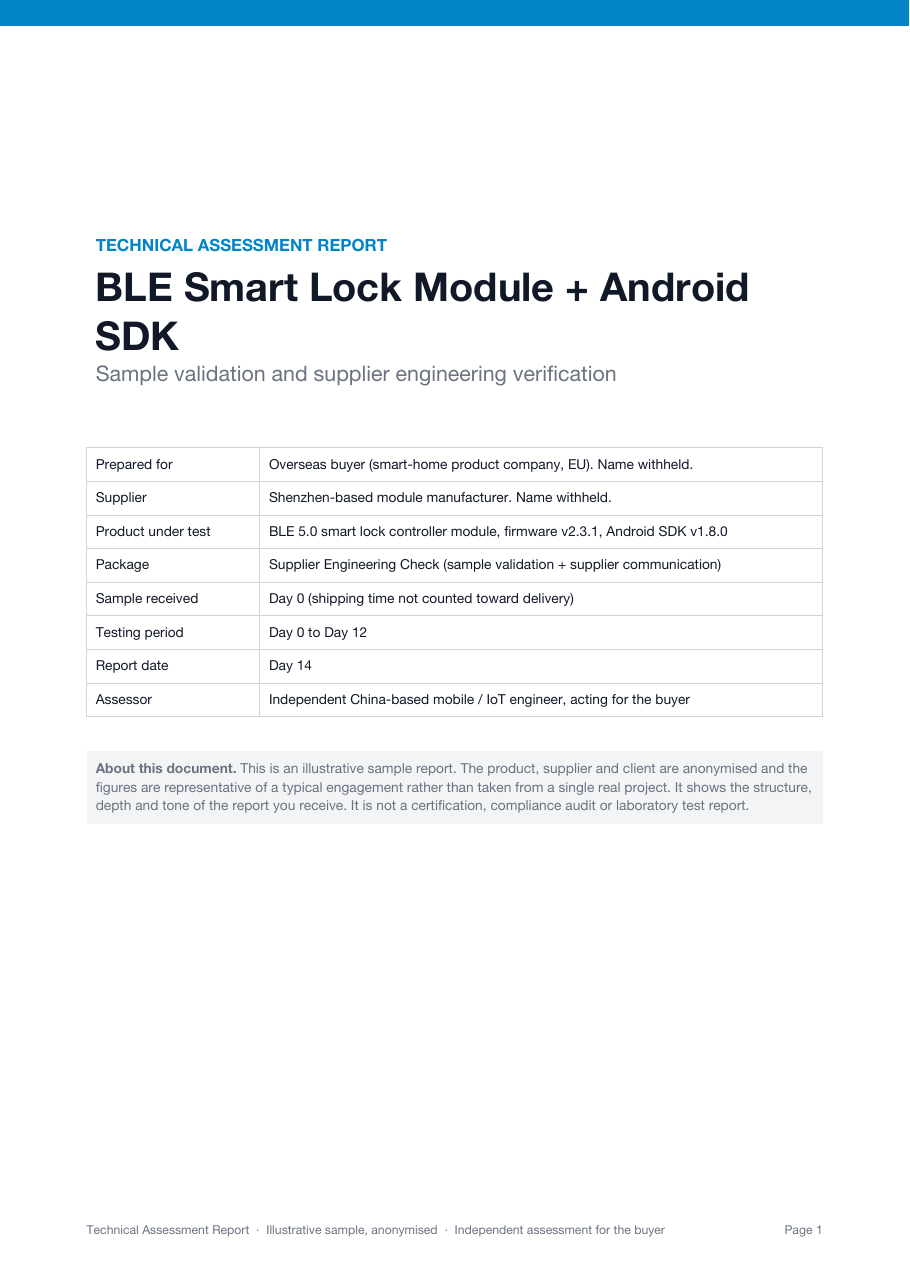
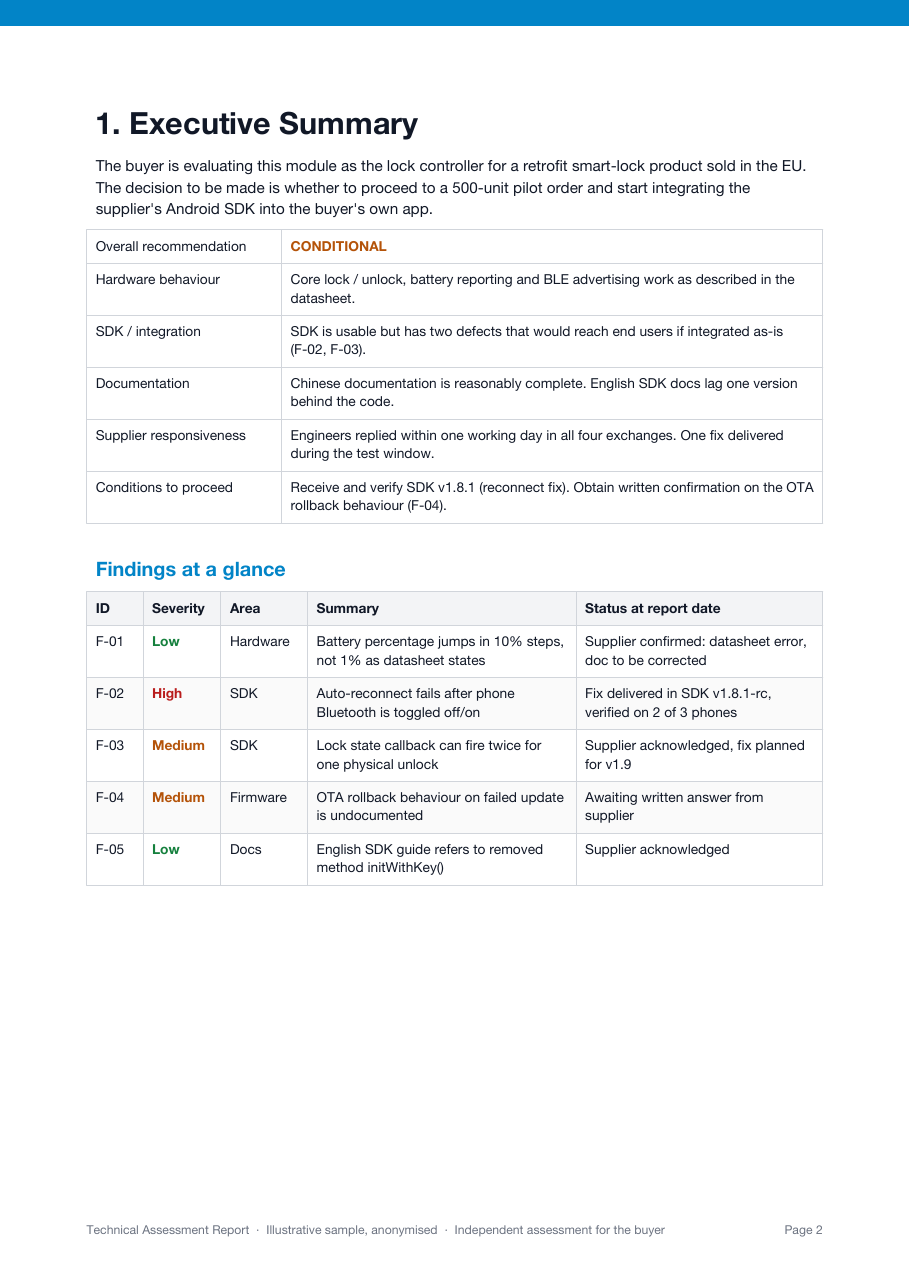
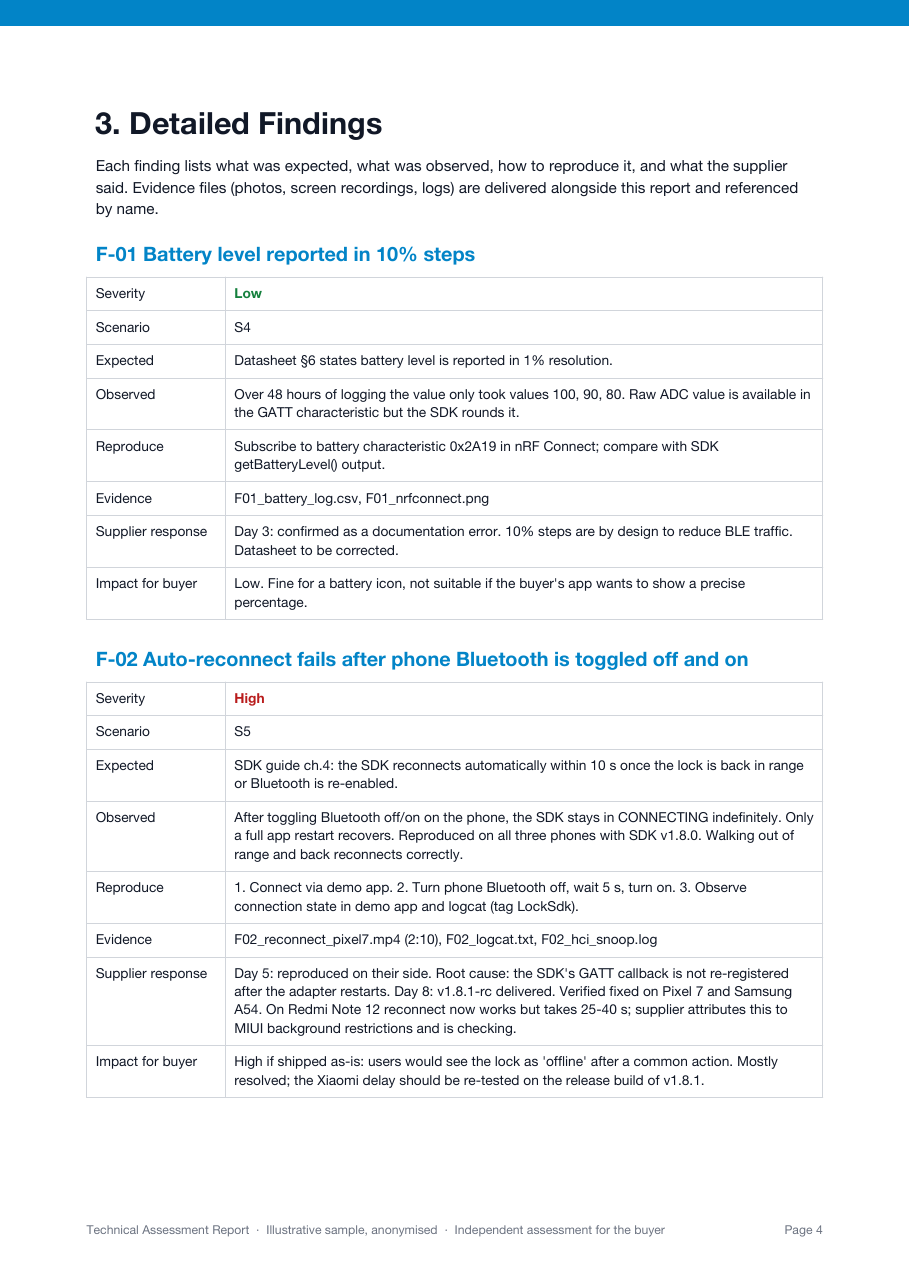
An eight-page example of an Advanced engagement: a BLE smart-lock module and its Android SDK, evaluated for a buyer deciding on a pilot order.
- Executive summaryVerdict, findings at a glance, conditions to proceed
- Scope and setupAgreed scenarios, out-of-scope list, test environment
- Detailed findingsExpected vs observed, reproduction steps, evidence, supplier response
- Supplier logEvery exchange with response time and outcome
- Risks and recommendationWhat to do next, and what to wait for
Illustrative and anonymised. The product, supplier and client are not real, but the structure and depth are exactly what a real engagement delivers.
About
Hi, I'm Raiden.
I'm a mobile and IoT engineer based in Qingdao. My background is Android and Flutter development, native SDK integration, smart-home and IoT devices, gateways, device-state synchronisation and real-hardware debugging.
That work often puts me between an app team and a Chinese hardware supplier: reading the Chinese documentation, reproducing what the device actually does, and getting a straight answer from the supplier's engineers. This service offers that role to overseas buyers who don't have someone in China.
I keep the scope narrow on purpose. One product, one supplier, one agreed list of things to check, and an honest report at the end, including when the answer is "this supplier isn't ready yet".
FAQ
Common questions
Is this a certification or compliance audit?
No. It's an independent technical assessment of how the device, SDK and API actually behave in the scenarios we agree. It is not an official certification, compliance, security or laboratory test, and the final verdict is an engineering opinion, not a legal or regulatory conclusion.
How does the sample get to you, and who pays shipping?
You or the supplier ship one sample to my address in Qingdao. From a Chinese factory that's usually one or two days and a few dollars. Shipping cost is yours, and transit time isn't counted in the delivery period; the clock starts when the sample arrives.
Can one order cover several devices?
No. Each order covers one supplier, one product and a list of functions agreed before testing starts. If you have several products or a longer list of scenarios, I'll send a custom quote so the scope and price stay clear for both of us.
Do you find suppliers? Will you talk to mine?
Finding suppliers isn't the core of this service; I assess the technical side of candidates you already have. In the Advanced package I communicate directly with your supplier's engineers in Chinese and send you an English summary of each exchange. I don't take commissions from suppliers.
Do you visit factories?
No. Samples are shipped to my bench in Qingdao and tested there. I work with the supplier's engineers by phone, WeChat and email. If you need an on-site production audit, a dedicated inspection company is the right choice; I can tell you what to ask them to check.
Can you test iOS?
Android, including Flutter, is my main test platform. iOS scenarios can be included when a project needs them, but please list them up front so we can confirm what's realistic. iOS isn't covered by default.
What do you need from me to start?
The product and supplier, what decision the result will support, the specific functions you want tested in priority order, any SDK, API or demo material you have, and the issues your team has already hit. The more specific the list, the sharper the report.